
 |
Suntiger Tarantula
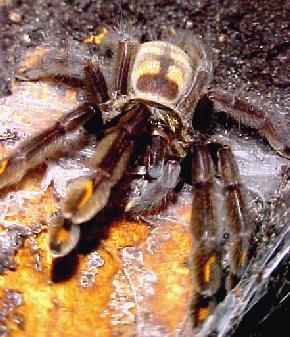
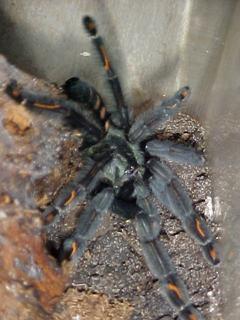
Psalmopoeus irminia These New World arboreals are some of the more striking tarantulas due to their dark legs, which are embossed with a bright pattern of orange on the metatarsi and tarsi. The carapace and pubescence surrounding it are green under the right light, especially fresh after a molt, and the dorsal side of the abdomen has a beautiful orange and black pattern. Though they share the similar habitat as Avicularia species, their forelegs are noticeably longer than their rear legs. The spermathecae are paired, not fused. . |
Range: As they are
often found in eastern Venezuela, they are dubbed with the name of "Venezuelan
Suntiger". They have also been collected in Guyana and their range may
extend into northern Brazil as well.
Habitat: Densely
vegetated, humid regions. They have a tendency to construct tube
webs at the base of structures in captivity.
Size: Fully grown,
they're about 6 inches in legspan.
Attitude: These
are rapid climbers that are sometimes prone to biting. They have
no urticating bristles, so they rely on their speed and fangs for defense.
Its predilection for quick bursts of running alone makes this species a
"do not handle" animal, whether or not the individual in question is a
biter. Breeding is fairly easy if the female is well-nourished, established,
and the male has spun a sperm web. Under those conditions, they can
cohabitate quite some time with little worry. If the aforementioned
conditions aren't met, the female often kills the male.
Dwelling:
They prefer climbing space, yet may often live near the ground (they'll
attach web to a vertical surface and make a soprt of "teepee"). There
is no shortage of webbing on their part.
Note the greenish color of the carapace after a molt. |

Note the difference in coloration of the male on the left. |

Here's a great overall profile. Understand that this species is not a "hand pet"- it climbed on my arm on its own accord while I was cleaning. |
Ideal Setup: A container
of approximately 2 1/2 to 5 gallons for arboreals that can be accessed
from its side. There should be climbing materials (cork bark, etc.) and
a thin layer of substrate at the bottom to retain moisture. Supply
a water dish and lightly moisten the substrate twice a week or so to keep
a good amount of humidity. You may also lightly mist the spider's
webbing. Keep the temperature around 75-80 degrees F if possible.
Food: Any climbing
bugs that haven't been exposed to pesticides (4-6 crickets per week), baby
mice, anole lizards, etc. They are great predators!
Eight
Home | Site
Map | Caresheets
© 1999-2006 Eight. All rights reserved.